I saw this today. All I can saw is I think the lady is pretty calm. Remeber if you see bees in a swarm like this they are as non-agressive as they ever are, and bees are usally pretty mellow. People wear bee suits of swarming bees with not a sting. Call a bee keeper and wait.
And here is one brave bee-keeper!
And one brave four year old - although I wonder if they are really bees, they do not usally swarm around food...
Showing posts with label bees. Show all posts
Showing posts with label bees. Show all posts
Thursday, March 25, 2010

Thursday, March 18, 2010
Beekeeping...
More cities are realizing that allowing small scale agriculture in the backyards of their cities is OK. And this is a good thing. So keep bees on your roof, have a flock of chickens in your backyard, raise an alpaca in your garage!

Well, maybe not an alpaca in your garage...

Well, maybe not an alpaca in your garage...
But chickens and bees are a great addition to any backyard. Well, almost any backyard, do check with your city first and understanding neighbors are always a plus!
Even New York City recently re-legalized beekeeping in the city of New York.
Thursday, February 5, 2009
More on bees...

A member sent this great bee article...
"The only honeybees left—i.e., the ones that started disappearing in October" (of 2007) "—had become the cows of the insect world: virtually extinct in the wild, hopped up on antibiotics, and more likely to reproduce via artificial insemination than by their own recognizance. "
It is sad but true...
Fed HFCS and under attack by varroa mites, bees are at the mercy of agri-business. We are lucky at my farm to have a bounty of native pollinators, bubble bees, mason bees, and others...
Tuesday, January 20, 2009
More about the bees...
A great article about the ongoing bee issue...
http://www.naturalnews.com/025287.html
"As the disappearance of honeybees continues, researchers are trying desperately to discover the cause of Colony Collapse Disorder (CCD). General consensus at this point is that there is more than once cause and the latest culprit may be genetically modified crops. This is one area of research being neglected as mainstream scientists insist GM crops are safe."
But is bT GMO corn really safe?
"Bees forage heavily on corn flowers to obtain pollen for the rearing of young bees. These pollen grains also contain the Bt genes of the parent plant, because they are present in the cells from which pollen forms. Mr. McDonald believes it may be possible that while Cry1Ab has no direct lethal effect on young bees, there may be some sub-lethal effect, such as immune suppression, acting as a slow killer."
Today Obama made a comment about us feeding the world. Given his choice of Secretary of Agriculture and his comments on our technology I have little hope that this means little more then spreading our GMO technology further... Hopefully we will do no more harm to world food systems then we have already done! And boy, have we done a lot already...
Friday, August 1, 2008
First the bees - Then...
 You just have to read this article on honey bees and insecticides.
I think we often are to quick to start widespread use of items before we really know what it means. Did we not realize that France had already seen a problem with nicotine based pesticides when in 2003, they saw widespread losses and banned these products.
There is an old story about a man who was spreading rumors. He confessed his sin and was told as penance to go to the top of a hill and release a pillow full of feathers. Thinking he got off rather easily he did so and came back to the priest. At which point we was told that now he must go and collect each and every feather for like feathers his words floated and spread until knowledge of their original source was lost. A task he decried as impossible, and it was...
I feel that is what we are currently doing. Unknown consequences and once unleashed it is impossible to bring back to undo what has been done. Perhaps, we should move slightly less quickly? Perhaps?
Friday, May 23, 2008
Strange new theory on Colony Collapse...
 This article is pretty scary...
In my day work we always recommend that clients install carbon dioxide sensors in conference rooms and other high occupancy areas so that if the CO2 level rises above 800 ppm the mechanical system of the building will bring in more outside air to lower that level to a healthier range.
This article suggests that bees are their own CO2 montoring system in their hives. Bees can sense CO2 and when the levels get to high they will adapt to try to lower it.
Is it possible that bees are sacrificing them selves to lower the CO2 in the hive? I kind of doubt this is the whole answer, because hives affected with CCD find only a few bees left... Certainly at some point of the CO2 induced exodus the remaining bees would sense a lower CO2 level. CCD hit in 2006-2007 the CO2 has not jumped that precipitously that more then a handful more bees would leave. Then also you would have expected to see much greater losses around major cities then you have...
and when the levels get to high they will adapt to try to lower it. Is it possible that bees are sacrificing them selves to lower the CO2 in the hive? I kind of doubt this is the whole answer, because hives affected with CCD find only a few bees left... Certainly at some point of the CO2 induced exodus the remaining bees would sense a lower CO2 level. CCD hit in 2006-2007 the CO2 has not jumped that precipitously that more then a handful more bees would leave. Then also you would have expected to see much greater losses around major cities then you have...
But perhaps this is just one more thing, which in combination with mites, diseases, feeding with corn syrup (made with bt producing GMO corn), Israeli acute paralysis virus, increase pesticide use, trucking colonies thousands of miles a season, and all the rest have caused us to reach the tipping point for bees...
I have to say (KNOCK ON WOOD) we have yet to loose a hive to CCD, although we have lost 2 in the past 2 years to other causes. If bees are the proverbial canary in the coal mine I think they are warning us of many things wrong with our world, and CO2 is just one part of that... Before we reach a greater tipping point...
Wednesday, April 23, 2008
New Bees...
 Did I ever tell you I am allergic to bees? Well I am. I was not when we first started keeping bees four years ago, but 18 months or so ago I was out looking at the bees, one stung me and I ended up in the ER with a pretty severe allergic reaction... So no more bee keeping for me (although I did start shots, I had to stop and will not be able to restart them for a couple more years.) So hubby is the beekeeper in the family now, and I get to watch from the safety of the truck, so you will pardon the photos, as I took them through a window...
I thought I would go through the process of putting bees in the hive, step by step... As I do, assure yourself it is as terrifying as it sounds the first time you do it, but by the time you've done it a couple times, it is easy, and you are no longer so scared, and you being calmer actually reduces your chances of being stung! Bees like calm, slow, steady movements.

The first thing you do each year (other then assembling your hives, which we buy pre-made,) is to make sugar water. New bees will have only the little honey you give them, and so will need a lot to eat which amounts to gallons of sugar water. One part water to 2 parts sugar and bring to a boil. So far this year we have made 150 pounds of sugar into sugar water! We will use a similar amount in the fall... We make so much we use a turkey fryer burner so it boils faster (I use the same thing when I can!)
The next thing you do is wait for the phone call to come and pick up your bees! Bees come in two or three pound boxes and in many different types, Italians, Russians, Carolions, New Worlds, Minnesota Hygienic, ect and each has different characteristics. This year we wanted to order two 3 pound boxes of Minnesota Hygienics, but there was a problem with our order, so we ended up with two 2 pound boxes of what we think are Itialians... In any case when that call comes the clock is ticking and you should go get your bees that day!
 The bees were shipped from California in the boxes and given a can of sugar water to sustain them through the journey, once that can is gone your bees can start to die! But here is a note to consider, if you are allergic, you should NOT go to bee pickup even if you are going to "wait in the truck" because they have just gotten a semi-truck full of boxes of bees and they will be buzzing every where! I almost had a panic attack sitting there, but no bees got in the truck, so that was good...
 The bees were shipped from California in the boxes and given a can of sugar water to sustain them through the journey, once that can is gone your bees can start to die! But here is a note to consider, if you are allergic, you should NOT go to bee pickup even if you are going to "wait in the truck" because they have just gotten a semi-truck full of boxes of bees and they will be buzzing every where! I almost had a panic attack sitting there, but no bees got in the truck, so that was good...
Once you get the bees you can spray them with sugar water and they can eat that, that will help sustain them until you can put them in their hives the next evening. When we opened the boxes one of the cans was totally out of sugar water and one only had a little left, this is why feeding is so important. You hive in the evening so they go into the box and learn where their home and don't fly off to a different hive during the day...
So now you have your bees, it's time to go set up your hives, which is a simple matter.

Now comes the fun part! First put your jacket on!
(You can see I was safely inside the truck with my EpiPen!)

Then carry your bees to the hives...

Then you have to try to pry the can out of the top of the box...

Remember this is a box full of bees!
 The next step is the most fun to tell people about! You rap the box firmly on the ground a couple times! The goal is to knock all the bees to the bottom. You do this so you can get the queen cage out, she is hanging next to the can of food... Notice in the next photo hubby has removed a glove. It is delicate work to remove the cork from the end of the queen's cage and replace it with a mini-marshmellow. The bees will eat through this and by the time they do they will have accepted the new queen, if you throw her right in without this step the bees will kill her...

Then you carefully hang her into the hive. Notice he has removed some frames to make way for the next step...
Which is to pour the bees into the hive. This involves shaking and tapping and wiggling a box of bees! Many of them will fall to the bottom of the hive, but quite a few end up in the air! (That's why I was in the truck!)
But first the box gets hit against the ground again so any bees who have started to climb fall to the bottom of the box... (Notice you have to hold the can over the hole as you do this...


Then you shake...
Notice the blurs in the photo? Those are the bees... You shake for a while... When you are done you replace the frames, being careful not to crush the bees who are piled on the bottom of the hive.
 Then you put all the pieces together, the little box over the main hive is the feeder, which we poured a couple gallons of sugar water into.
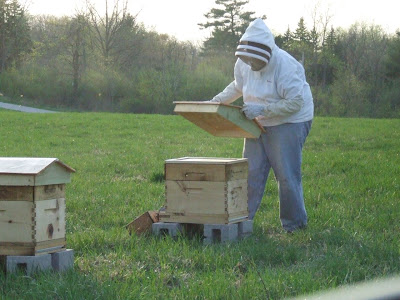
You leave the box near the hive entrance, because there are always stragglers who are still in the box and will find their way to the hive...
All done, two hives set up. As we lost one colony over the winter this will bring us to four, but one is really strong and we are going to split it into two which should give us 5 or 6 by the end of the summer (although we will not pull honey from the hives we split this year.)
I hope people enjoyed this, as it took a long time to post! Now you know what it takes to start a hive, not that hard, so if you've ever thought of being a bee keeper you should do it!
Tuesday, February 26, 2008
Add sugar to the list...

Sugar. I love my sugar. I will admit it. People who say they don't like it, have to be lieing in my mind.
I use organic cane in my coffee and day to day uses, but come Christmas time, jelly time, and other high sugar use times I buy it in bulk. Costco sells 10 and 25 pound bags of beet sugar from Michigan. I figure it's local for sugar, and I buy it.
Those days may be about to end and with them the pints of jelly given out like water and the hundreds and hundreds of cookies I use as standard Christmas fare (my cookie boxes this year each held 4-6 dozen cookies and I did 12, even before I had any for all the Christmas events and my husbands cookie habit.)
Am I getting lazy? Figuring that it is easier to buy a $15 dollar gift then give a box of laborious cookies (which have $10 in ingredients anyway?) No. Nothing that easy...
After a preemptive strike from the EPA of changing the allowable Glyphosate residue (Round-up) in sugar beets by 5000 percent (you read that right five THOUSAND percent) the stage is cleared for GMO sugar beets.
One of the problems with this is that beets are wind pollinated. Organic beet growers will need to be more then 3 miles (MILES) away from GMO sugar beets to ensure that their beets are not contaminated. Because containing any GMO genes (even accidental) means no organic certification. Plus Monsanto has a habit of suing people whose crops are contaminated by their genes, for usurping their intellectual property!
Then what about all the items I buy now looking for "sugar" instead of High Fructose Corn Syrup in the ingredient list. Breads, pasta sauces, jellies, sodas! ICE CREAM! Will I be forced to organic for all of these to avoid GMO, as now I buy organic corn products...
 Then there is the issue of my bees. My poor bees. We feed them sugar water spring and fall to make up for the honey we rob from them. And WOW can bees eat sugar water, gallons a week. Natural beekeepers feed their bees sugar water instead of high fructose corn syrup (partially to avoid the GMO in HFCS) that the commerical beekeepers use. But now what? Feed the bees organic sugar? I guarantee you will not be able to afford the resulting honey. And some people have suggested that colony collapse disorder might be exacerbated by GMO foods, not to mention the increased herbicide (Glyphosate) load in the sugar which my delicate bees are now eating...
This is a brave new world we live in. One where most people seem to be keeping their eyes closed!
Subscribe to:
Posts (Atom)